
Crown movement without long layers
Shorter internal length makes it easier to move visual fullness upward rather than letting the top collapse.
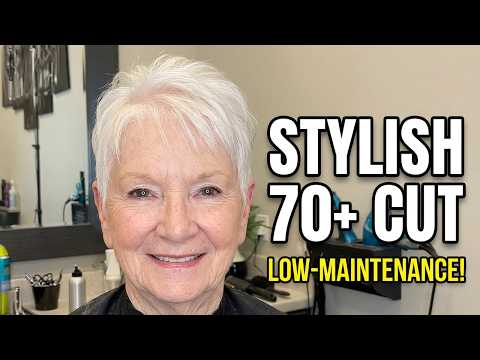
In RaDona's current over-70 salon and YouTube library, one transformation stands out enough to carry the title “The Most Requested Haircut for Women Over 70.” Sharon, 76, traveled from Idaho for a soft, piecey short shape with crown movement, controlled texture and easy everyday styling.

It sits in the short-hair family between a classic textured Pixie and a longer, softer Bixie depending on how much side and perimeter length a client keeps.
In RaDona Ludlow's current salon and BGH video library, a soft, piecey short haircut is one of the strongest requested looks for women over 70. Sharon, 76, traveled from Idaho for the transformation. The shape uses controlled crown layers for movement and fullness, keeps the silhouette light, and can be customized with more or less fringe, ear coverage and nape length.
“Most requested” here refers to RaDona/BGH's own salon and video evidence—not a claim that every salon or every woman over 70 requests the same haircut.
Sharon made the trip from Idaho for a fresh, piecey short shape. The cut focuses on movement and apparent fullness without requiring a long morning routine.
The appeal is not the label. It is the balance of lift, softness, movement and manageable styling.
Shorter internal length makes it easier to move visual fullness upward rather than letting the top collapse.
The front and sides can retain enough softness that the haircut still feels feminine and personal.
Controlled separation gives the eye movement without requiring a large, teased silhouette.
There is less hair to dry and direct, which matters when daily simplicity is part of the goal.
Keep more side length for softness or shorten the nape and ears for a crisper Pixie direction.
Sharon's full transformation gives a better reference than one carefully posed front-view photo.
The same general look can turn into a Pixie, Bixie or soft stacked short cut depending on four areas.
The top needs enough internal shortening to lift, but not so much texturizing that fine or low-density hair becomes see-through.
More ear exposure pushes the cut toward Pixie. Longer tuckable pieces make the same idea feel softer and more Bixie-like.
A longer, side-swept front softens the haircut; a shorter fringe makes the overall shape feel crisper and more open.
Decide how much perimeter you want to keep. That one choice often determines whether your stylist should interpret this request as a Pixie, Bixie or soft short layered cut.
Use the video like a consultation reference. Watch the starting hair and the shape change, not only the reveal.
Compare Sharon's density, texture and current length with your own.
Notice how much is removed around the ears, nape and front.
Watch where RaDona creates movement through the crown and top.
Look at the side and back—not just the front-facing finish.
Use these real transformations to move shorter, softer or more perimeter-heavy without abandoning the same basic goal.
Choose this direction if you want more ear/nape exposure and even faster daily styling.
Watch Darlene
Choose this if you like Sharon's movement but want more side length and a softer exterior.
Watch the Bixie
Use this to compare how a more clearly Pixie-shaped perimeter changes the same short-hair idea.
Watch the PixieThis is where a strong salon consultation matters. Piecey movement can help fine hair look lively, but removing too much hair from already sparse areas can do the opposite.
| Your Hair | How to Adapt Sharon's Shape | What to Avoid |
|---|---|---|
| Fine + good density | More freedom for crown texture and piecey separation | Heavy product that collapses roots |
| Fine + low density | Keep more perimeter; texture selectively | Thinning shears through sparse ends |
| Thin temples | Keep longer side/fringe pieces for coverage | Automatically exposing the weakest area |
| Flat crown | Shorten enough top weight for lift | Keeping length solely for security |
| Thick / dense | Remove internal bulk so the shape moves | Letting the sides become triangular or puffy |
Women over 70 often wear glasses daily, so the ear area should be part of the haircut plan rather than an afterthought.
A shorter side makes glasses and earrings more visible and keeps frame arms clear.
More length lets you soften the temples or tuck the hair depending on the day.
A longer fringe or cheek-level front can make a short haircut feel less cropped from the front.
“I like the soft, piecey short haircut RaDona gave Sharon at 76. I want the crown to have [soft / moderate / strong] movement. Keep the sides [covering part of my ear / tuckable / above my ear]. I want the front around [brow / cheek / mouth]. Keep the nape [soft / lightly tapered / short and clean]. My hair density is [high / medium / low], so please do not remove more texture than my hair can support. I spend about [2 / 5 / 10] minutes styling.”
Do not rely on the word “piecey” alone.
How much lift and separation do you want?
Covered, tuckable or fully exposed?
Short, side-swept or longer for softness?
Soft and longer or compact and Pixie-like?
Where should weight be preserved, and where can it safely be removed?
Show the full transformation so your stylist can see starting hair, side profile and finished movement.
Open Sharon's videoThe right page should help you decide not to choose the haircut when another shape solves your priorities better.
If lower-edge weight matters more than crown lift, a compact Bob may suit the goal better.
Bobs for Older WomenIf a short Pixie-like side feels too exposed, a Bixie keeps more exterior softness.
Bixies Over 70If ease and maximum crown lift matter more than perimeter coverage, a compact Pixie may be the cleaner answer.
Pixies Over 70Sharon's transformation is the proof page. The cluster pages help you narrow the exact variation.
Compare more shapes across Pixie, Bixie, Bob, fine hair, gray hair and maintenance.
Women Over 70 HubChoose the haircut by strand diameter, density, crown lift and perimeter.
Fine Hair Over 70Compare where you want the lift, perimeter and coverage to live.
Compare All Three
RaDona is a licensed cosmetologist and Utah salon owner with more than 25 years behind the chair. Her video library is valuable because women can see the starting hair, the decisions made during the cut, the side and back views, and the final movement before they choose a similar haircut.
Sharon's trip from Idaho is a good example of why BGH's strongest pages should be built around real transformations rather than generic model galleries.
Use the transformation as a reference, then customize it to your density and coverage preferences.
In RaDona's current BGH salon/video evidence, Sharon's soft, piecey short cut is a standout requested transformation.
It belongs to the piecey short-hair family and can lean Pixie or Bixie depending on side, nape and perimeter length.
It combines easy crown movement, a lighter silhouette, softness around the face and relatively simple everyday styling.
It can be, but texturizing should match density. Fine, low-density hair needs more perimeter preservation.
Specify crown lift, fringe length, ear coverage, nape length, density and how much daily styling you want.
Bring Sharon's video to the appointment rather than relying only on the haircut name.
Watch SharonStart with Sharon's transformation. Decide how much crown movement, fringe, ear coverage and nape length you want. Then adjust the haircut for your density instead of asking your stylist to copy one still photo exactly.