
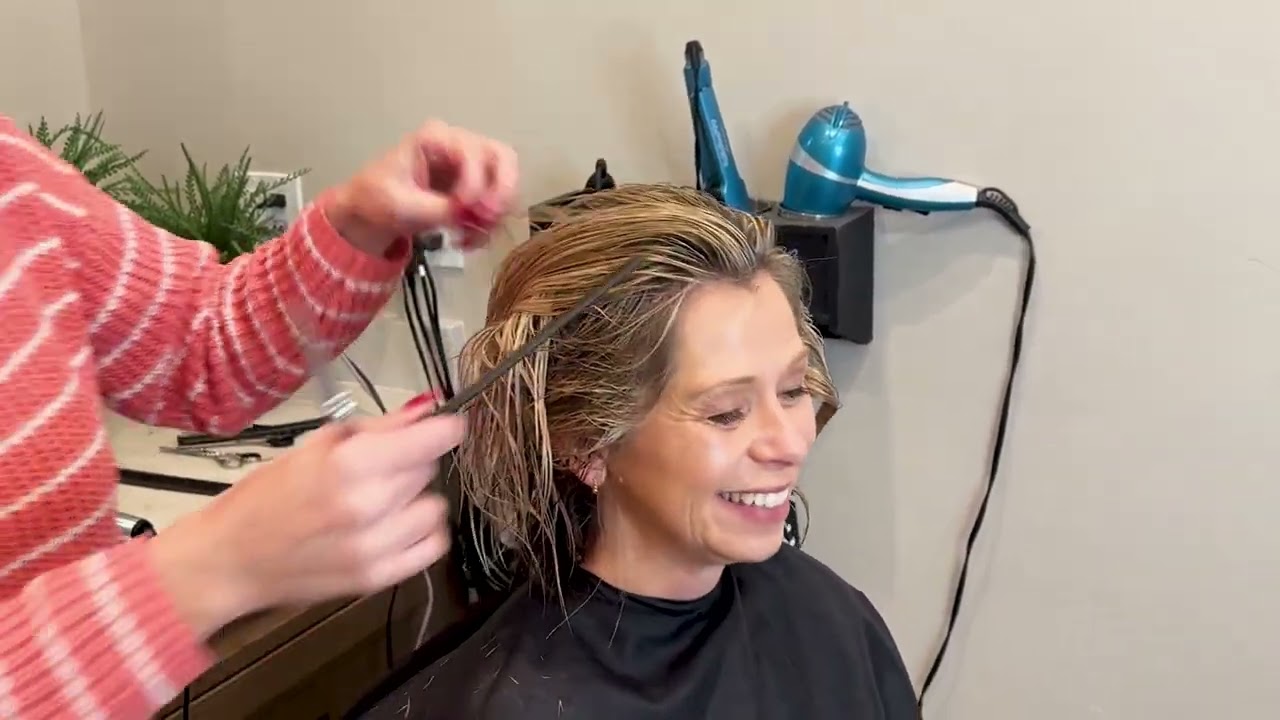
DeeAnn's Glow-Up
DeeAnn's Story — Why She Finally Made the Change
DeeAnn had been thinking about going shorter for a long time. Like many women over 50 she'd spent years maintaining a length that took time every morning, never quite looked the way she wanted it to, and felt like it belonged to an earlier version of her rather than the woman she is now. The hair she'd kept "just in case" — just in case she wanted to put it up, just in case she changed her mind, just in case shorter didn't suit her — was holding her back more than she realised.
What she wanted was something modern. Something that required less work but looked more polished. Something that framed her face the way her current style never did. RaDona's answer: the bob — specifically tailored for her face shape, her hair texture, and the way she actually lives her life.
Why the Bob Is the Right Cut for Women Over 50
The bob's dominance at this stage of life isn't a trend — it's a structural reality. Here is exactly what it does for mature hair that other cuts can't.
Hair in the 50s and beyond often maintains healthy growth at the root and scalp, while the ends — years of accumulated dryness, heat, and colour — tell a different story. A bob removes exactly those ends, immediately revealing the healthiest hair you have. The result looks like a product of investment when it's actually a product of subtraction.
Long fine hair shows scalp through the length because each strand has to cover more distance to the end. A bob removes that distance — the hair stacks on itself at the perimeter, creating the illusion of density that no product can replicate. For women with fine or thinning hair, the bob is the single most effective visual tool available.
A well-cut bob on the right hair type styles itself. Wash, rough-dry with fingers, one pass of a round brush to set the ends under, a small amount of product. Done. Women who've spent 20–30 minutes on longer hair every morning reclaim those minutes permanently. That's over 150 hours a year.
Longer styles on fine mature hair often draw attention to what the hair lacks. A bob directs attention upward — to your eyes, your cheekbones, your expression. The face leads. Women who've felt invisible in their hair consistently report feeling seen again after a great bob. It's not vanity. It's geometry.
What RaDona Did: The Technique Behind DeeAnn's Bob
Every great bob has three decisions made before scissors touch hair: the length, the angle, and the layers. Get these right and the cut does the rest by itself. Here's what RaDona chose for DeeAnn and why.
- 1Established the perimeter length — at the jaw, not the chinFor women over 50, the jaw-length bob consistently outperforms the chin-length bob for one reason: it avoids the widest point of most faces. The chin is typically narrower than the jaw; a bob ending at the jaw provides the broadening effect that balances the face without creating extra width. For DeeAnn specifically, this length also covers the jawline in a way that's immediately softening and flattering.
- 2Added an A-line angle — shorter at the back, slightly longer at the frontA flat, one-length bob around the head sits heavy and boxy on most women over 50 — particularly if there's any natural thickness in the hair. RaDona cut a subtle A-line: the back sits 1–1.5 inches shorter than the front, creating a diagonal line that adds movement and lifts the perceived weight of the hair. From the side, the hair appears to flow naturally rather than sitting like a helmet. It's a small angle but a significant difference.
- 3Interior layering — removed weight without removing lengthRather than taking layers at the perimeter (which would reduce the bob's visual density), RaDona worked through the interior sections — lifting and cutting to remove the bulk that was making the hair lie flat and heavy against DeeAnn's head. The perimeter stays at the guide length, maintaining the clean bob line. The interior is lighter, which allows the hair to move and breathe rather than sitting flat.
- 4Point-cut the perimeter throughoutBlunt scissors cuts create a perfectly flat edge that looks stiff on mature hair and grows out as a harsh line. Point-cutting (angling scissors vertically into the perimeter) creates a slightly textured edge that moves naturally, reflects light in multiple directions, and grows out cleanly over 6–8 weeks rather than going blunt and heavy. Every perimeter cut on DeeAnn's bob was point-cut.
- 5Blow-dried with a round brush to set the shapeThe final step is where a great bob haircut becomes the great bob result — the blow-dry. RaDona dried section by section with a 2-inch round brush, rolling the ends under and lifting the roots simultaneously. This sets the shape the cut created: smooth volume at the crown, ends that curl cleanly under. The finished look is polished but effortless — the kind of result that makes people ask if you've just come from the salon even three days later.
The Bob Variations — Finding Your Version
DeeAnn's bob is one version. The bob family is wide — and the right variation for you depends on your hair texture, face shape, and how much styling you actually want to do each morning. Here are the four most flattering for women over 50.
Cut at one length with a clean, consistent perimeter and no interior layering. The uniform edge makes the hair appear denser than it is — the eye reads the perimeter as a full, solid weight of hair rather than seeing individual strands. This is the correct choice for women whose primary concern is thinning. It requires the most frequent trims (every 5–6 weeks) to maintain the edge, but no morning effort — the shape is self-evident.
Interior layers remove weight from the mid-section while the perimeter retains its clean line. The result sits off the head with natural movement rather than lying flat. This is the version RaDona cut for DeeAnn — and the most frequently requested bob at her Utah salon for women over 50. Works on all face shapes. Requires a round brush on wash days; air-dries acceptably on non-wash days. Grows out gracefully.
Shorter at the back, gradually longer at the front — the diagonal creates a flattering frame that draws the eye forward and downward, elongating the face visually. The longer front pieces also create something to tuck behind the ear, a soft sweep across the cheek, or a half-up option for variety. A-line bobs grow out with a natural direction rather than going boxy, making them the most forgiving for women who stretch their salon visits.
Sitting at collarbone length rather than the jaw, the lob is technically still a "long" style but produces most of the bob's benefits: removes the damaged ends, adds structure and movement, requires significantly less styling than truly long hair. For women over 50 who want the benefits of going shorter but aren't ready for the full commitment, the lob is the right first step. Most clients who start at lob length move to a true bob within one or two appointments.

Which Bob Is Right for Your Face Shape
| Face shape | Best bob | Key detail | What to ask for |
|---|---|---|---|
| Oval | Any — layered bob most recommended | Natural proportions; every bob variation flatters | "Layered bob, jaw length, point-cut ends" |
| Round | A-line or chin-length with longer front pieces | Longer front pieces create visual elongation; avoids width at the widest point | "A-line bob, longer in front, no blunt fringe" |
| Square / strong jaw | Layered bob with soft textured ends | Soft layers and point-cut perimeter reduce the angular jawline visually | "Layered bob, point-cut throughout, soft not sharp ends" |
| Heart (wide forehead) | Bob with soft side-swept fringe | Fringe narrows the forehead; chin-length adds visual width below the narrowest point | "Bob with side-swept fringe, chin to jaw length" |
| Long / oblong | Blunt bob or lob with fringe | Horizontal fringe and uniform length create visual width, breaking vertical emphasis | "Blunt bob with fringe, above-chin to chin length" |
| Diamond | Lob with volume at sides | Collarbone-length lob adds width at the jaw; avoids the narrow lower face looking narrow | "Lob with soft layers for side volume" |
Styling the Bob Every Morning — RaDona's 5-Step Routine
The promise of the bob is morning efficiency. This is the exact routine RaDona walks every client through before they leave the salon — including DeeAnn.
- 1Rough-dry to 80% with fingers firstRough-dry without a brush first — tipping your head forward and lifting the roots away from the scalp while the dryer runs. This creates root lift that lasts all day. Getting the hair to 80% dry before a brush touches it means the brush styling phase takes under 3 minutes rather than 8.
- 2Finish with a 2-inch round brush — ends under, roots upSection the bob into top and bottom. Working section by section with a 2-inch round brush: roll the ends under as the dryer follows the brush downward, and lift each section slightly at the roots as you begin. The combination of ends-under and roots-lifted is what gives a bob its characteristic polished shape — full at the crown, smooth and curved at the perimeter.
- 3One small amount of product — cream or light waxA pea-sized amount of styling cream or light wax worked between palms and smoothed through the mid-lengths and ends. This tames flyaways, adds a subtle sheen, and gives the ends the definition that makes the bob shape read clearly. Do not apply to roots — it flattens the volume you just created with the brush.
- 4Check the shape from both sidesBefore leaving the mirror, check the bob from both sides and from the front. The shape should be symmetrical and the ends should curve under evenly. Any section that didn't cooperate gets a 10-second touch-up with the round brush — one single roll — and it's done. Never try to re-do the whole thing at this stage; spot correction is faster and more effective.
- 5One light pass of hairspray — the sealFrom 14–16 inches away, one light pass of flexible-hold spray seals the shape without stiffness. This is what takes the bob from lasting 2 hours before flyaways appear to lasting all day. Light hold — not firm hold — is the right choice for a natural finish. Total time from wet to finished: 5–7 minutes.
Keeping Your Bob Looking Its Best
| Task | Frequency | Why it matters |
|---|---|---|
| Full salon trim | Every 6–8 weeks | Bobs lose their shape gradually — the perimeter thickens and the interior fills in. 6 weeks is sharp; 10 weeks is beginning to look grown-out. 8 weeks is the practical sweet spot for most women. |
| Fringe trim (if applicable) | Every 4–5 weeks at home | Fringe grows into the eyes before the rest of the bob needs attention. A careful home trim with sharp scissors extends the salon cut significantly. |
| Deep conditioning mask | Once per week | The ends of a bob — which are the most visible part of the cut — need consistent moisture to maintain the healthy sheen that makes the style look expensive. Apply from mid-length to ends; keep off the roots. |
| Clarifying wash | Once per month | Styling product accumulates at the bob's perimeter and at the roots, gradually dulling both the colour and the movement. One clarifying wash monthly restores the hair's natural light-catching quality. |
| Colour or toning (if applicable) | Every 6–10 weeks | The bob's shorter length means colour refreshes faster and covers less surface area — both reducing cost per visit and keeping the result looking fresher for longer than on longer hair. |