
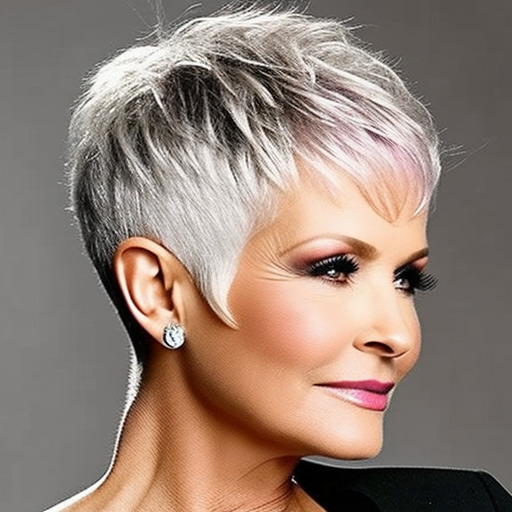

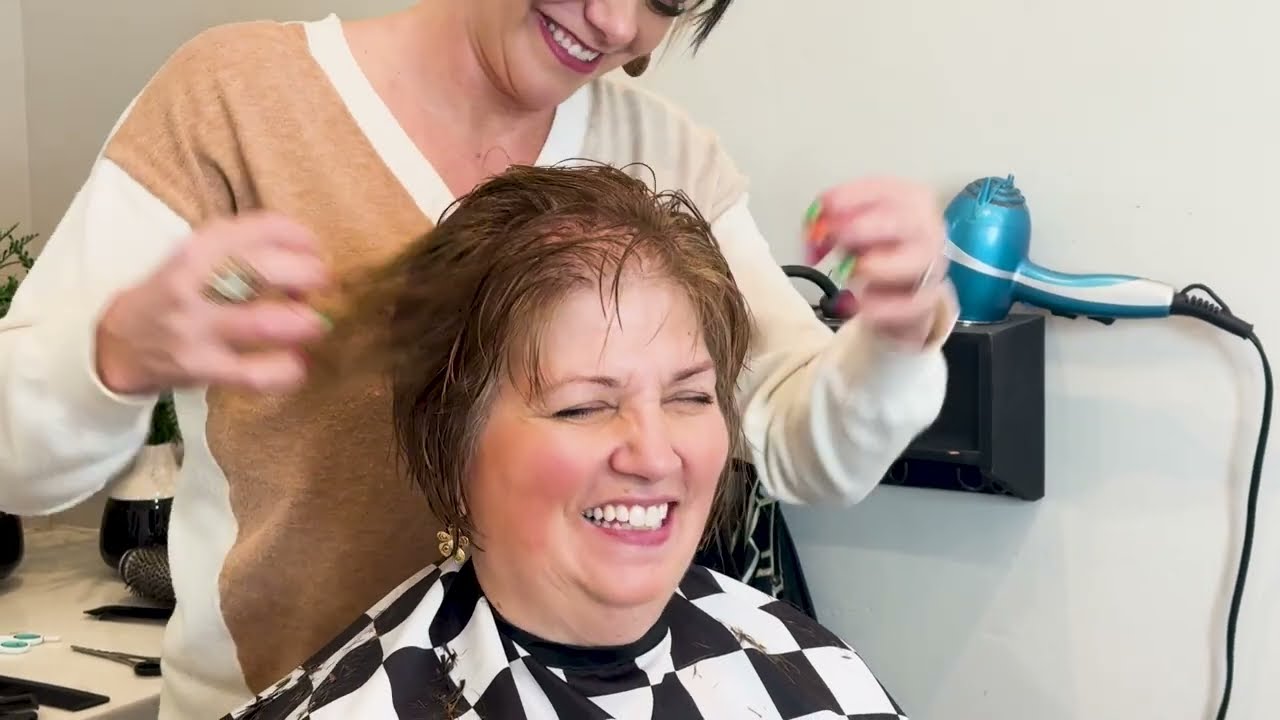
The women who struggle with the transition are usually fighting against a narrative — that grey hair means old, or that stopping colour means letting yourself go. Neither is true, and both are worth examining before you choose your method. The clients RaDona has seen go gray and love it have one thing in common: they made the decision for themselves, not against themselves. That mindset matters more than which transition method you choose.
Watch: Real Transformations from the Channel
These videos show the before-and-after reality of gray hair transitions and beautiful silver styles — from salon transformations to the specific pixie and bob cuts that flatter natural grey most beautifully.

The Three Transition Methods — Which Is Right for You
There is no single correct way to go gray. The right method depends on how much colour is currently in your hair, how much of your natural grey has come through, how quickly you want to complete the transition, and what you can tolerate looking like during the in-between phase. Here is each method with complete honesty about what it involves.
Stop all colour appointments entirely and allow the natural grow-out to happen without assistance. The coloured length gradually grows down and is cut away over time as new grey emerges from the root. This is the most direct route — and also the most visually challenging during the middle phase, when the hair has a distinct two-tone appearance: grey at the top, coloured at the bottom.
The cold turkey method works best for women who have significant grey already (50%+ at the root), who are willing to cut the length regularly to accelerate the removal of coloured ends, or who are starting the transition alongside a substantial haircut that removes most of the coloured length at once.
- ✓Zero ongoing colour cost from day one
- ✓Fastest route to fully grey hair
- ✓No salon appointments required during transition
- ✓Best paired with a short haircut that removes most coloured length immediately
- ×Demarcation line is visible for months
- ×The two-tone phase (months 3–10) can feel awkward
- ×Requires either patience or significant length removed
- ×Very difficult with heavily coloured, long hair
Fine highlights — in tones 1–2 levels lighter than your existing colour — are placed strategically through the areas where grey is most visible (temples, part line, crown). As the grey grows in, it merges with the lighter highlight tones rather than creating a harsh demarcation line against darker colour. The transition happens gradually and naturally over 6–12 months without any visually awkward phase.
This is the method RaDona recommends most often for women in their 40s and 50s who are beginning to see significant grey. It buys time, it looks intentional at every stage, and it significantly reduces the frequency of colour appointments — typically from every 5–6 weeks to every 10–16 weeks as the grey increases.
- ✓No awkward demarcation line at any stage
- ✓Looks beautiful and intentional throughout
- ✓Reduces appointment frequency significantly
- ✓Works at any length
- ✓Gives time to adjust to the silver before going fully grey
- ×Still requires salon visits every 10–16 weeks
- ×Higher cost than cold turkey (though lower than full colour)
- ×Slower route to fully grey than cold turkey
- ×Requires a colourist who understands the technique
A middle path between cold turkey and highlight blending: stop colour appointments and manage the transition purely through regular haircuts that progressively remove the coloured length. Every 6–8 weeks, more of the coloured ends are trimmed away as grey grows down from the root. With consistent trimming, the demarcation line shortens steadily rather than sitting in the same visible position for months.
This works best for women who are starting with shoulder-length or shorter hair — where the coloured length can be progressively removed without the extreme length sacrifice that cold turkey requires on long hair. It also works well if you're prepared to go shorter than you currently are as the transition proceeds.
- ✓No colour cost from the start
- ✓Controlled and gradual — nothing drastic
- ✓Regular trims keep the hair looking intentional
- ✓Natural pace — no rush
- ×The demarcation line is still visible between trims
- ×Slower than cold turkey unless you trim aggressively
- ×Difficult to manage on long hair without going much shorter
- ×Requires patience and a plan with your stylist
| Your situation | Best method | Why |
|---|---|---|
| 50%+ natural grey already visible at root | Cold turkey + haircut | You're more than halfway there — a good cut removes the contrast quickly |
| Heavy colour, long hair, first grays | Gray-blending highlights | Cold turkey would mean a very long awkward phase; highlights manage it gracefully |
| Shoulder-length or shorter, moderate colour | Gradual grow-out or cold turkey | Shorter length means less coloured hair to remove; manageable without highlights |
| Want to be fully grey in under 12 months | Cold turkey + aggressive trims | Fastest route — pair with a pixie or very short bob |
| Want zero awkward phase | Gray-blending highlights | The only method that keeps you looking polished at every single stage |
| Budget is a primary concern | Cold turkey or gradual grow-out | Zero ongoing colour cost; regular trims only |
The Gray Transition Timeline — Month by Month
What you will actually see at each stage — and what to do about it. This applies to cold turkey and gradual grow-out. Gray blending highlights skip most of the awkward phases below.
1–2
Natural grey growth at the root is visible but minimal — typically ¼ to ½ inch. Most women find this stage the most exciting: you can see exactly what your natural grey looks like and assess whether it's white, silver, salt-and-pepper, or a mix. The contrast with the coloured ends is not yet jarring. This is the stage to commit to your method and tell your stylist your plan.
3–5
This is the stage where most women consider giving up. The grey root section is now 1–2 inches long and clearly visible against the coloured ends. The hair has a two-tone appearance that feels unfinished and deliberate in the wrong way. This is completely normal and completely temporary. Three things help: a gloss treatment to soften the colour difference (ask your colourist), regular trims to reduce the coloured length, and a style that draws attention to the face rather than the hair. The demarcation stage is temporary. Everyone who gets through it is glad they did.
6–9
The grey section now extends 3–5 inches from the root. The overall balance of grey to colour has shifted — you're more than halfway there. This is when most women start to feel the decision was right. The natural grey at this length begins to show its full character: the tonal variation, the luminosity, the way it catches light. The coloured ends, by contrast, can look flat and one-dimensional. Many women at this stage choose to make an accelerating cut — removing the last significant chunk of coloured hair to complete the transition faster.
10–14
For most women, the last coloured ends are cut away somewhere between months 10 and 14, depending on growth rate (average: ½ inch per month) and how much length was removed during the process. The final few inches of old colour may look very different from the rest — older, drier, perhaps a different tone from years of accumulated colour. This is normal and temporary. One good trim removes them. What remains is entirely your own.
14+
You're here. The hair is entirely your natural colour. Now the work is care, not transition: purple shampoo weekly to keep silver bright, deep conditioning weekly to replace moisture, and a cut schedule that keeps the style fresh. This is also when many women make a style decision — a pixie, a bob, a shorter version of what they had — because the hair at this point looks its best at a length that shows off the silver rather than weighing it down.
The Best Cuts During the Grow-Out Phase
The right haircut does two things during the transition: it removes coloured length progressively (accelerating the process) and it keeps the hair looking polished and intentional rather than in-between. These are the cuts that do both.


Silver Hair Care — The Non-Negotiable Routine
Natural grey and silver hair is beautiful. Dull, yellow, dry grey is a care problem — not a colour problem. These are the rules that keep silver luminous at every stage of the transition and after.
Purple shampoo deposits violet pigment that neutralises the yellow and brassy tones that develop in natural grey and white hair. Used once weekly it keeps silver looking cool, bright and intentional. Used daily it over-deposits and creates a blue or purple cast. One day per week — swap your regular shampoo for purple, leave on for 3–5 minutes, rinse. Do this every week without fail and the difference is dramatic.
Natural grey hair is more porous than pigmented hair — it absorbs and releases moisture faster, which means it dries out faster. A rich conditioning mask applied from mid-length to ends after shampooing, left for 5 minutes minimum, replaces that moisture weekly. The visible result: hair that reflects light rather than absorbing it, and ends that look healthy and intentional rather than dry and dull. This is not optional after the transition.
Grey and white hair sustains heat damage more visibly and more permanently than pigmented hair. One missed application doesn't cause disaster; the habit of skipping it causes cumulative dryness and breakage that dulls the silver over months. Apply to damp hair before any heat tool — dryer, diffuser, flat iron, curling wand — every single time. Non-negotiable.
UV exposure yellows and dulls natural silver significantly faster than it affects pigmented hair. A UV-protective hair spray or leave-in with UV filters worn on sunny days — particularly in summer, at the beach, or for outdoor sports — protects against the yellowing and oxidisation that even the best purple shampoo routine struggles to reverse once established. Apply like sunscreen: before exposure, not after.
Product build-up dulls silver hair faster than almost anything else — particularly if dry shampoo, hairspray, or styling products are used regularly. Once monthly, replace your regular shampoo with a clarifying shampoo to strip residue completely. Follow immediately with the deep conditioning mask to replace the moisture stripped in the process. After one clarifying wash, the natural luminosity of the silver is visibly restored. Most women notice it within a single appointment.
What Nobody Tells You — The Emotional Stages
This section is for the women who've googled this at midnight, unsure whether to go through with it. RaDona has heard every version of this at the salon chair.
You can always go back. Colour is not permanent in the sense of hair decisions — it grows out, or it can be reapplied. The worst case scenario for trying a gray transition is that you return to colour. That's not a failure, it's information. Almost every woman RaDona has seen go back to colour did so in the first three months. Almost none of the women who made it past month six ever went back.
The women RaDona sees fully transitioned to natural grey — with a great cut and a silver care routine — consistently report the opposite reaction. People ask if they've done something different, whether they've been on holiday, whether they've changed their skin care. A well-maintained silver is striking and distinctive in a way that one-dimensional permanent colour rarely is.
The research on this is consistent: the thing that most ages a woman's appearance is not grey hair — it's the wrong cut, dry and neglected hair, or a style that no longer works for her current face shape. Silver hair that is properly cut and cared for looks intentional, modern and confident. That is the opposite of what most women picture when they imagine "letting themselves go grey."
This comes up more often than most women want to admit. RaDona's honest advice: the women who make this decision for themselves — because they want to, not because someone else does or doesn't — are consistently happier with the result. The opinion that matters most in the salon chair is yours.