
Why Short Hair After 50 Makes Structural Sense
Fine hair in the 50s loses density at the root. No product creates structural volume — only the cut does. A layered bob or textured pixie creates volume by changing the shape of the hair, not by coating it. This is the volume that lasts all day rather than the volume that deflates by 11am.
The last several inches of long hair in the 50s often carry decades of accumulated colour, heat and dryness. A short cut removes them completely, revealing the healthier, more vital hair underneath. The result looks like a product of considerable investment. It's the opposite.
A well-cut pixie or textured bob styled correctly takes 5–10 minutes from towel to door. Women who've spent 25–30 minutes on longer hair every morning reclaim those minutes permanently — over 150 hours a year. The quality of the result, at that time investment, is also significantly higher.
Long hair past the shoulders on fine mature hair often draws attention downward — away from the eyes, cheekbones and expression. A short cut redirects attention upward and forward, to the face itself. Women who felt invisible in their hair consistently report feeling noticed again after a great short cut. It is not vanity. It is geometry.
Watch: RaDona's Short Haircut Tutorials
Three videos from the channel — a complete pixie transformation on a mature woman, RaDona's full short salon technique, and real gray-hair short style inspiration.
The 15 Styles
The foundational short style for women over 50 — and the most requested in RaDona's Utah salon for good reason. Short on the sides and back, slightly longer and textured at the crown and temples, with a razor-finished neckline that follows the natural hairline. The classic textured pixie is not the severe, slicked-down crop of decades past. It is modern, soft, and has enough length at the top for volume and daily variation.
Routine: mousse on damp hair, diffuse or rough-dry upward, a fingertip of matte clay pressed through the crown pieces. 5–7 minutes. Works on every hair type. Particularly striking on natural silver.

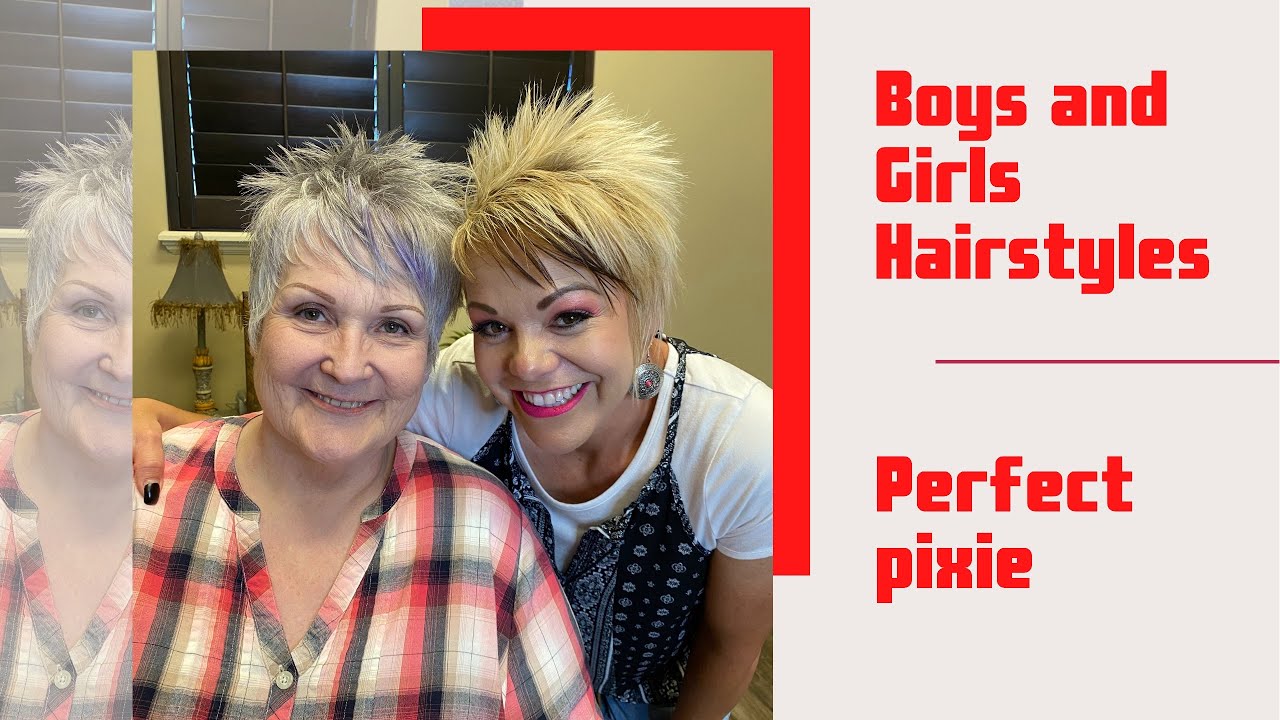
Natural silver or grey hair in a pixie cut is one of the most visually striking combinations in women's hairstyling at any age. The tonal variation in natural grey — the mix of lighter and darker strands — catches light from every angle simultaneously. At pixie length, the weight that has been dragging the curl and wave down is gone, and what's left springs freely and expressively. If you have natural grey, the silver pixie is the cut that shows it at its most extraordinary.
Care addition: purple shampoo once weekly keeps the silver bright and cool. A deep conditioning mask weekly maintains the luminosity. Full care guide: Gray Hair Transition Guide.
For women who want to go short but aren't ready for the classic close-cropped pixie: the longer pixie sits between the pixie and the bob — longer pieces at the sides and front, shorter at the back, with the nape and sides tapered in. This is sometimes called the pixie-bob or bixie. It has the low-maintenance quality of a pixie without the dramatic shortness that makes some women hesitate. It also grows out more gracefully than a classic pixie — each stage looks intentional rather than neglected.
This is frequently the first short cut for women over 50 who have worn their hair longer for years. The commitment feels smaller; the result often inspires them to go shorter at the next appointment.

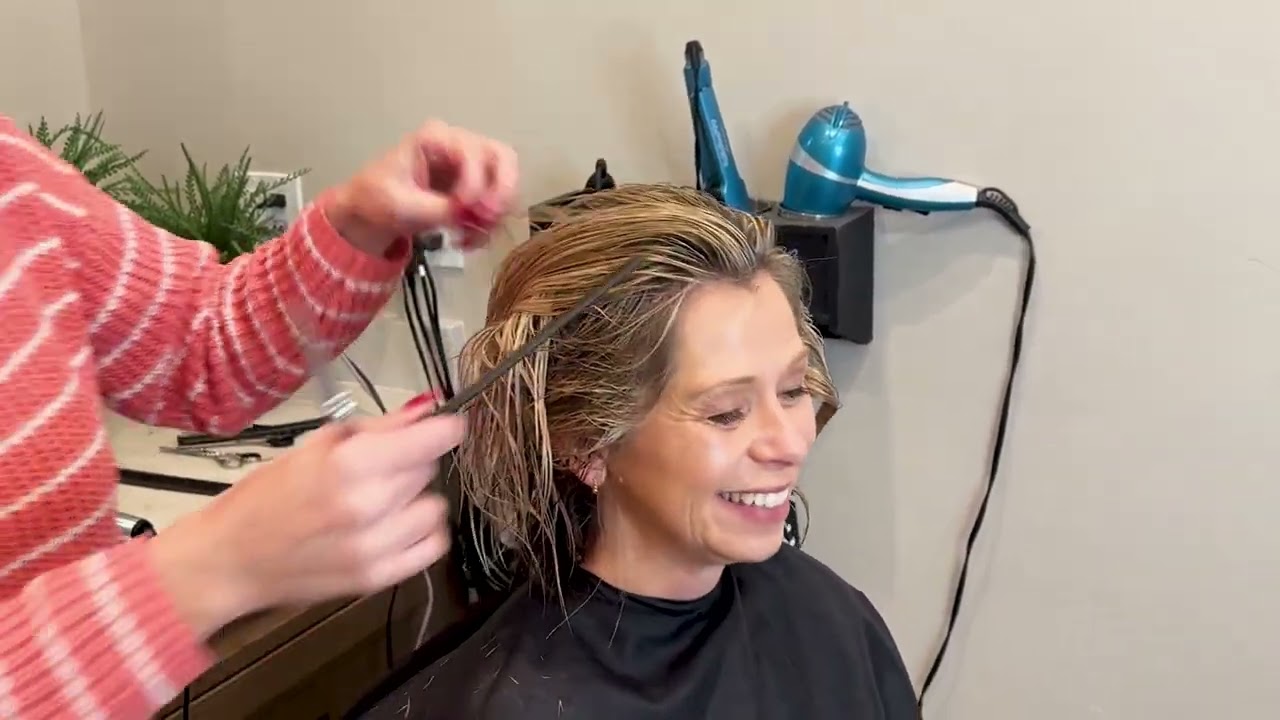
The jaw-length layered bob is the single most popular style in RaDona's salon for women over 50 — the one that consistently produces the most enthusiastic reactions when clients see themselves in the mirror. Interior layers remove the weight that makes fine mature hair lie flat against the head, creating movement and volume the hair couldn't generate on its own. The perimeter stays clean and full. The result: polished, face-framing, and absolutely effortless to maintain. Full guide: Perfect Bob for Women Over 50.
Styling: rough-dry with fingers for root lift, one pass of a round brush rolling the ends under, light styling cream. Under 8 minutes.
Cut at one consistent length, all the way around, with a clean perimeter and minimal internal layering. The blunt bob is the maximum-thickness-illusion style for fine hair — the uniform edge reads as a dense, solid weight of hair from every angle. Where the layered bob suits normal-to-thick hair by removing weight, the blunt bob suits fine hair by concentrating and emphasising every strand. Linda's salon result (above) shows exactly what this achieves at 61: clean, deliberate, full of apparent density.
Maintenance note: blunt bobs need trimming every 5–6 weeks to maintain the edge. The perimeter thickens as it grows and loses the clean line that makes this style work. Weekly deep conditioning keeps the ends looking sharp rather than dry.
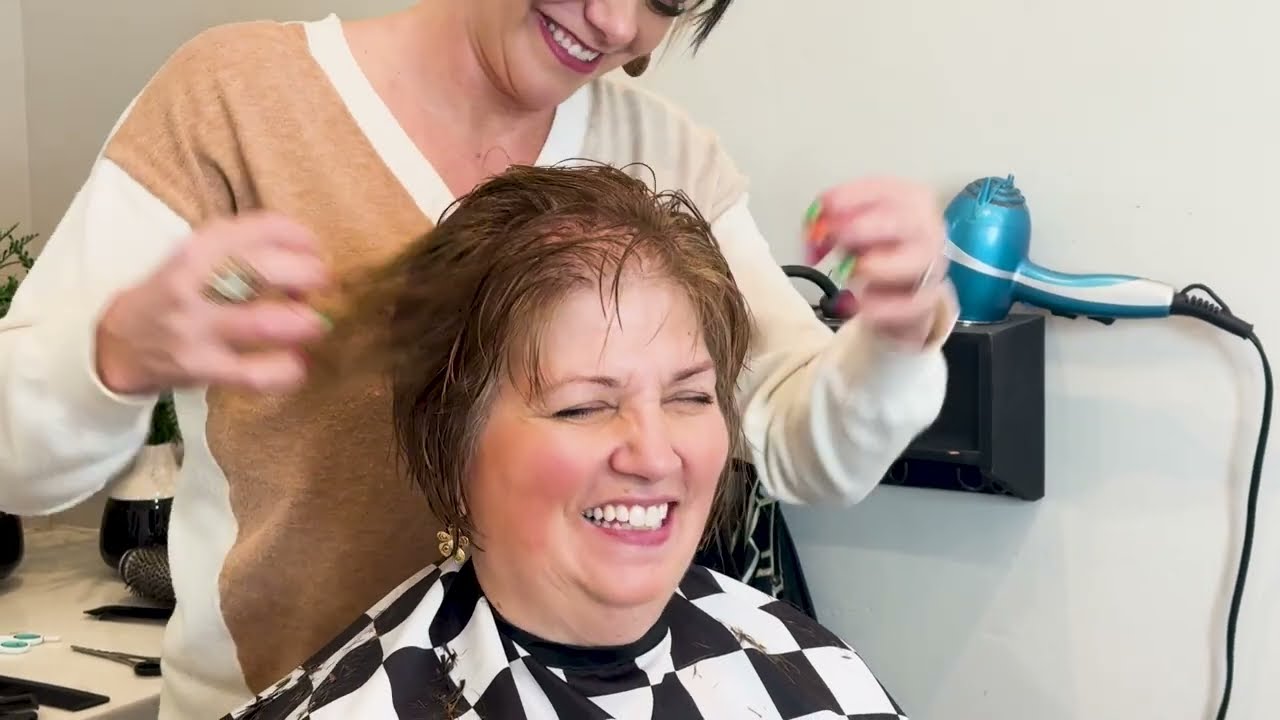
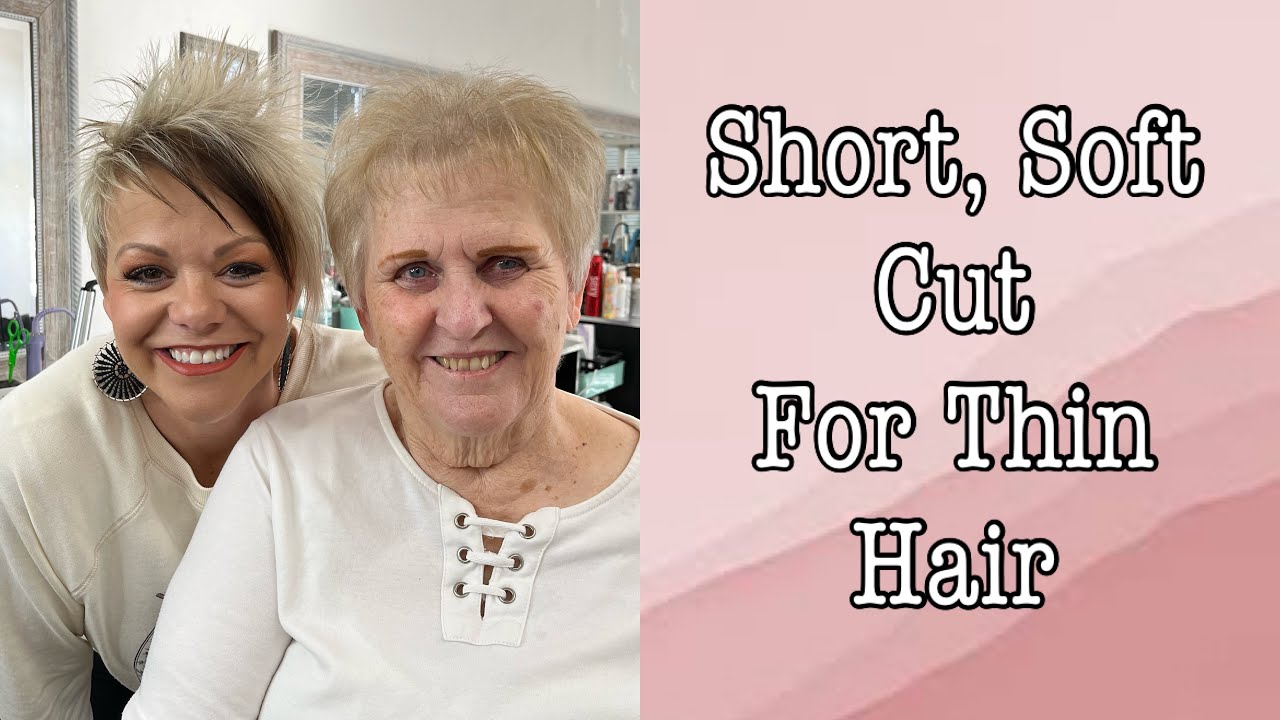
Shorter at the back than the front — the A-line creates a diagonal from nape to jaw that is one of the most face-flattering shapes in women's hairstyling. The shorter back provides lift and a rounded silhouette; the longer front pieces frame the jaw and cheeks. For women over 50, the A-line bob has the additional benefit of drawing the eye forward and upward — toward the eyes and cheekbones — rather than down toward the jaw. It grows out with a natural direction rather than going boxy, making it the most forgiving bob variation between salon visits.
Works on straight and wavy hair. On naturally wavy hair, the A-line's diagonal shape creates beautiful movement as the wave accentuates the angled line from back to front.
Stacked layers at the back create a rounded, full silhouette that lifts away from the head rather than lying flat. The graduation builds volume precisely where fine mature hair is usually flattest: at the crown and nape. From the side, the silhouette curves and rounds rather than lying straight down. The front pieces are kept longer to frame the face. For women over 50 with fine hair who want the maximum volume effect from their cut, the stacked bob delivers more than any product can replicate structurally.
Requires slightly more maintenance than the layered bob — a round brush blow-dry on wash days maintains the rounded shape. On non-wash days, a lift spray at the roots refreshes it in 2 minutes.

A jaw or chin-length bob combined with a soft wispy fringe is one of the most specifically flattering style combinations for women over 50. The fringe draws the eye to the eyes rather than the forehead, softens the face vertically, and adds a horizontal element that balances rounder or longer face shapes. The word "wispy" is critical — point-cut, not blunt across. A blunt fringe can look heavy on mature faces. A wispy fringe sits softly, moves naturally, and frames without dominating.
Fringe maintenance: trim every 4–5 weeks as it grows into the eyes faster than the rest of the bob. A home trim with sharp scissors (cut sections when dry, point into the ends) extends the salon cut significantly.
For women over 50 with natural wave or curl, the curly pixie is a revelation. Long curly or wavy hair in this decade is often heavy, tangled, and fighting its own natural pattern. Cut to pixie length, the weight is removed and the curl springs fully free — more coil, more spring, more energy than it had at any longer length. In natural silver tones, curly pixie hair catches light extraordinarily. The tonal variation in grey combined with the light-catching angle of each curl creates a visual richness no solid colour can produce. Full guide: Curly Pixie Haircuts.
Daily routine: mousse on wet hair, diffuse on low 5 minutes, fingertip of clay on crown. Total: 5–7 minutes. Cut dry, curl-by-curl — ask specifically.
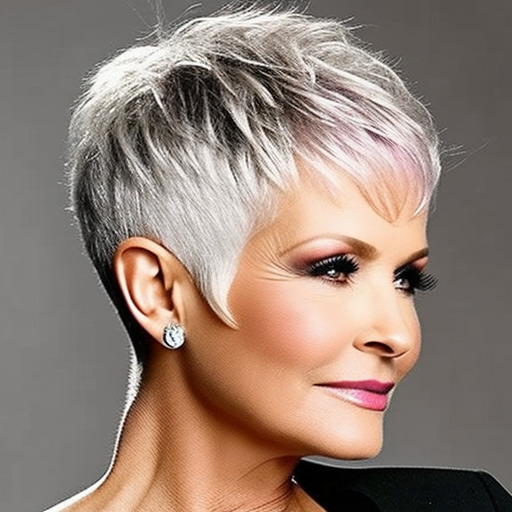
Shorter overall than the classic pixie — close at the sides and back, with the crown section left slightly longer and styled upward for lift and texture. The textured crown creates visual height that counteracts the face-widening effect that very short hair can have on rounder faces. A small amount of matte clay or texture paste worked through the crown pieces gives each section definition and lift. For women with thicker hair who want the lowest possible maintenance and the boldest possible statement, this is the cut.
Maintenance: this style grows out very quickly and needs trimming every 3–4 weeks to maintain the close sides and the proportional relationship between the short sections and the textured crown.
A classic pixie length with longer front pieces swept to one side — typically across the forehead or toward the ear on the non-dominant side. The sweep creates asymmetry that is immediately face-framing and softening. It draws the eye diagonally across the face rather than straight down, which is universally more flattering on mature faces than a centred, symmetrical style. A gentle side-sweep also helps camouflage temples and forehead in a natural, unstudied way.
Styling: blow-dry the front section to one side with a soft round brush, use a small amount of light wax or cream to hold the sweep. Touch up midday with a single finger stroke. Stays all day with a light hairspray pass.
For women over 50 with natural wave — or who have developed wave as their texture changes — the wash-and-go bob is the practical dream. Cut short enough that the wave shows from the root, products applied on soaking-wet hair, diffused on low or air-dried. No round brush. No heat styling. The wave does the work that styling used to do. This is the style that gets "what did you do differently?" comments without doing anything at all. Full technique guide: Wavy Hair Tutorial.
The cut must be done dry or after diffusing — cutting wet misses the wave's shrinkage and produces a different length than the finished result. Ask specifically.
The curtain fringe — long, centre-parted, falling either side of the face — combined with a short bob is one of the most modern and widely flattering looks of the current moment. Unlike a full fringe, the curtain version reveals part of the forehead centrally while framing the upper face with soft pieces on either side. For women over 50 it accomplishes three things simultaneously: it modernises the look, it softens the forehead without covering it, and it focuses attention on the eyes and cheekbones. Works on every face shape.
Styling the curtain fringe: blow-dry each side outward and slightly downward with a small round brush. 60 seconds. The result looks intentionally styled for the whole day. A light flexible-hold spray seals it.
A short bob paired with a very short, wispy micro-fringe sitting at or above the brows. Not for the hesitant — this is a statement style. The micro-fringe modernises the bob dramatically, creates an immediately distinctive look, and draws attention to the eyes with particular force. On women over 50 who have the right forehead for it (neither very high nor very narrow), it can look extraordinary. Requires confidence to wear, but rarely fails to generate strong positive reactions.
Maintenance: micro-fringes grow very quickly — a home touch-up every 2–3 weeks is necessary to maintain the proportion. Use sharp scissors and cut dry, point-cutting into the ends rather than cutting straight across.
A bob specifically engineered for fine, thinning hair over 50 — combining internal layers that remove mid-shaft weight, a slightly elevated crown section cut with more length than the sides to allow root lift, and a point-cut perimeter. When styled with a volumising thickening spray and a round brush rolling sections upward at the roots, this cut creates the most dramatic volume effect available at bob length for fine hair. It is the cut RaDona reaches for when a client says "my hair is so flat and thin — I need help." This is the help.
Key product: volumising thickening spray applied to damp hair before blow-drying. Bonds to each strand and increases its apparent diameter. More impactful for fine mature hair than any conditioner, serum or tonic available. Shop RaDona's picks: Amazon Storefront.
Face Shape Quick-Match Guide
Natural proportions work with every style. The textured pixie, layered bob, and curly pixie are all exceptional.
Height at crown, diagonal lines, and asymmetry elongate. Side-swept pixie and A-line bob both redirect the eye upward.
Soft fringe and wispy ends reduce angularity. Curtain fringe and side-sweep draw the eye diagonally rather than squarely across the jaw.
Curtain fringe and soft side-sweep narrow the forehead visually. Bob with fringe is the single most effective style for this face shape at 50+.
Width at chin level balances the narrow jaw. A-line and layered bob with jaw-length front pieces add visual width where the face is narrowest.
Fringe and horizontal elements shorten the face. Blunt bob and curtain fringe create width that breaks the vertical emphasis.
Maintenance Schedule by Style Length
| Style category | Full trim | Touch-up | Daily routine | Styles in this guide |
|---|---|---|---|---|
| Classic & close pixie | Every 4–5 weeks | Neckline: every 2–3 weeks | 5–7 minutes — mousse, diffuse, clay | 1, 2, 10 |
| Longer pixie / pixie-bob | Every 5–6 weeks | Neckline: every 3 weeks | 7–8 minutes — rough dry, light cream | 3, 11 |
| Short bob (chin to jaw) | Every 5–6 weeks | Fringe (if present): every 4–5 weeks at home | 7–10 minutes — round brush, light spray | 5, 7, 8, 10, 13, 14, 15 |
| Layered / A-line bob | Every 6–8 weeks | Fringe trim as needed | 7–10 minutes — rough dry, round brush ends | 4, 6, 12 |
| Curly / wavy versions | Every 6–8 weeks (cut dry) | None — wash and go | 3–5 minutes — mousse, diffuse or air dry | 9, 12 |
| Silver / natural grey | Per style above | Purple shampoo weekly; deep condition weekly | Same as base style + weekly silver care | 2, and any with natural grey |