
Style the Part First
Comb the hair into the part and direction it will normally be worn. Do not cut a fringe while forcing it into an artificial position.
Bangs go wrong fastest when too much hair is sectioned or too much length comes off in one pass. The safer method is to part the hair where it will actually be worn, start longer, use light tension, remove small amounts, then dry/style before refining.

RaDona repeatedly works in stages: establish the section, leave extra length, cut lightly, style or dry the fringe, then decide whether more needs to come off.
That matters because hair can lift, bend, shrink, split around a cowlick or sit differently once the tension from your fingers is released.
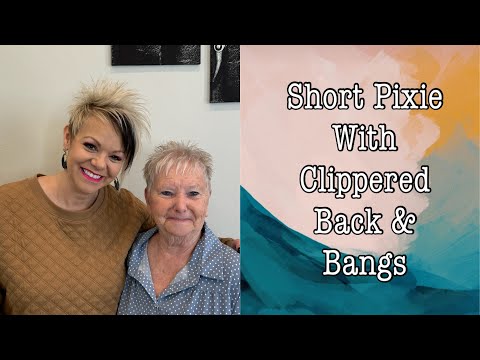
The exact style in this older tutorial is piecey and directional, but the decision process is broadly useful: comb the hair as it will be worn, avoid forcing every piece to the same length, remove length gradually and use the styled result as feedback.
This is the shared workflow. The exact angle changes for straight, side-swept and curtain bangs.
Comb the hair into the part and direction it will normally be worn. Do not cut a fringe while forcing it into an artificial position.
Clip the rest away and start with less hair than you think you need. A section that is too deep or wide creates a heavier fringe than intended.
Hold the fringe down lightly, then relax your grip enough to see where the hair wants to sit. Strong tension can make the finished fringe spring shorter.
Remove a small amount first. RaDona repeatedly leaves room to go shorter rather than trying to hit the final line immediately.
For softness, use small point-cutting/open-close motions. Side-swept and curtain bangs need deliberate angles rather than a straight-across line.
See where the fringe actually lands after it is dried and styled. Only then make small final corrections.
These examples show how the technique changes with the fringe shape.
The method changes depending on whether you want a hard line, diagonal sweep, center split, light wisps or child-friendly face framing.

RaDona cuts Avery’s bangs dry, keeps the section controlled and point-cuts rather than forcing one hard line.

The fringe is cut on an angle and connected progressively into the side length.

Shorter near the center, longer toward the sides, then softened so the fringe can split and fall back naturally.
A newer channel example centered on a light, wispy front rather than a dense block of bangs.

Scarlet’s real haircut keeps the center around nose-to-lip length and blends the fringe into longer face-framing sections.

A mature-women example showing how extra fringe length changes the front without requiring a completely different haircut.
A straight fringe is built around a more level lower shape; a side-swept fringe uses a diagonal and gradually connects into longer side hair.
Avery’s tutorial is especially useful because she is growing part of an older heavy fringe out. RaDona isolates only the hair that should remain bangs.
RaDona’s side-bang tutorial uses one section as the guide for the next and keeps the outside edge longer.
For children, the first requirement is cooperation: the child must be seated and able to hold still while an adult handles the shears. RaDona starts conservatively, uses a triangle section, keeps the center around nose-to-lip length and blends the fringe gradually toward the sides.
The fix is usually not a clever trick. It is a slower process with smaller decisions.
Starting too deep or too wide creates a heavy block of fringe. Start smaller; add more only if needed.
Pulling the hair tightly downward can make it spring shorter after release.
Leave extra length, style the fringe, then refine. Bangs offer very little room for a big overcut.
A straight-across motion will not create a side sweep or curtain shape. Decide the fringe geometry first.
The natural growth direction can split or lift a fringe. Strong cowlicks are a good reason to use a stylist.
RaDona specifically cautions against aggressive texturizing close to the scalp/hairline.
Curly fringe can finish much shorter once dry. Cut cautiously and respect the natural curl pattern.
If a child cannot sit still, stop. The safest option is to wait or use a professional appointment.
The more precise and shorter the fringe, the sooner it feels grown out. Longer side-swept and curtain bangs are more forgiving.
| Bang style | What grows out first | Best trim approach | Maintenance pressure |
|---|---|---|---|
| Straight / full | Eye-line length | Dry, controlled section; point-cut in small amounts | Highest |
| Side-swept | Shortest inside point | Re-establish diagonal without shortening the outside edge too much | Moderate |
| Curtain | Center pieces | Keep center shorter, blend gradually longer toward sides | Moderate / forgiving |
| Wispy | Random pieces reaching eyes | Trim only the pieces disrupting the intended light shape | Low to moderate |
| Curly | Individual curls | Assess dry pattern and shrinkage before shortening | Texture-dependent |
| Kids fringe | Hair entering eyes | Adult-led, small dry check, stop if child cannot remain still | Depends on length |
Use a professional when you are making a major change, working around a strong cowlick, cutting very short baby bangs, managing significant curl/shrinkage, fixing a previous mistake or cutting a child who cannot hold still.
A consultation is also useful when you want the bangs integrated into a Pixie, Bob or layered haircut rather than treated as a separate front section.
The teaching sections above use transcripts; these high-view examples show durable audience interest.
 #1
Strong long-term audience proof for soft center-parted fringe.
Watch the bangs video → #2
A high-view side-fringe example tied to a full haircut.
Watch the bangs video → #3
Useful proof that fringe density changes the look as much as length.
Watch the bangs video → #4
The exact general bang-cutting tutorial used as this page’s primary teaching embed.
Watch the bangs video →This page should not compete with Pixie-with-bangs, Bob, Kids or Face Shape pages. It teaches the cutting technique and sends visitors onward.
Use this branch for technique and DIY haircut education.
Use these when the visitor already knows the haircut family.
Use these when the cutting question is specifically about a child.
Use Avery for straight bangs, the side-bang tutorial for a diagonal sweep, Ellie for curtain bangs and Scarlet when the fringe is for a child.
RaDona is a licensed cosmetologist and salon owner in Nephi, Utah who has worked behind the chair since 2000. The guide is built from multiple real fringe demonstrations rather than one generic set of instructions.
Across straight, side-swept and curtain tutorials, the consistent principles are the same: control the section, avoid excessive tension, leave extra length, use the correct angle for the fringe shape and assess the hair after styling before taking more off.
When the hair pattern or correction is complex, use a professional rather than forcing a home trim.
RaDona often prefers to trim bangs dry because she can see where they actually sit. Wet cutting can work, but hair may lift, shrink or change direction as it dries. For a cautious home trim, dry and styled as normally worn gives clearer feedback.
Start longer than the intended final length, use light tension, remove small amounts, then dry or style the fringe and reassess. RaDona repeatedly trims in stages rather than committing to the final length in one pass.
Only if a very blunt effect is truly the goal. RaDona commonly point-cuts or uses small open-and-close snips so the edge looks softer. Side-swept and curtain bangs are intentionally cut on an angle.
Use only the amount of hair needed for the desired fringe density. A section that is too wide or too deep creates heavier bangs than intended. Start conservatively; more hair can be added later.
Create a controlled front section, keep the center shorter and angle gradually longer toward the sides. RaDona’s curtain-bang tutorials also show soft point cutting and dry checking before taking more length.
An adult should do the cutting. Keep the child seated and still, use a small controlled section, leave more length initially, and stop if the child cannot stay still. Scarlet’s 2025 tutorial shows a parent-friendly curtain-bang approach.
It depends on the length and style. Short straight fringe may need frequent touch-ups, while curtain and side-swept bangs usually have a more forgiving grow-out. Small trims are safer than waiting and removing a large amount at once.
A professional is the better choice when the fringe involves a strong cowlick, significant curl/shrinkage, a major correction, very short baby bangs, or a child who cannot remain still.
Choose the fringe shape, watch the matching RaDona video, leave extra length and let the styled result tell you whether anything else needs to come off.