Hairstyles for Thin Hair Over 50
Choose the haircut by where your density is missing—not by the word “fine.”
Thin hair and fine hair are not the same problem. Fine hair describes the diameter of each strand. Thin hair describes lower density—fewer hairs or more visible scalp. That distinction changes the haircut.
If your crown is thinning, you may need shorter lift. If your temples are thin, you may need to keep more length. If your ends are transparent, the perimeter may matter more than layers. This guide starts with one question: Where is your hair actually thin?
Salon guidance: RaDona Ludlow, Licensed CosmetologistFocus: reduced density, not strand diameterPublished: November 5, 2026
Real density-specific salon lessonKeep coverage where density is weakest
This page has a different job from the fine-hair keeper.It routes haircut decisions by density loss: crown, part, temples, perimeter or diffuse thinning.
QuestionWhere?is density missing
GuardrailFine ≠ Thindiameter vs density
GoalCoverageplus believable lift
RaDona25+ yrsbehind the chair
The density-first answer
What are the best hairstyles for thin hair over 50?
The best cut is the one that protects hair where density is lowest and removes weight where density is strong enough to support lift. That can mean a Pixie for a flat crown, a Bixie for thinner temples, a blunt Bob for transparent ends, or a longer side-swept shape when front-corner coverage matters more than maximum height.
Do not automatically add lots of layers or texturizing because the hair looks flat. With truly low-density hair, removing too much can create more visible scalp instead of more volume.
Thin crown: shorter support + directional lift.
Widening part: broken/side part + controlled volume.
Peggy is fine-haired—but RaDona says she has “quite a bit” of hair.
That one moment explains why these pages must stay separate. Peggy's strands are fine, but her density is strong enough that RaDona can use substantial interior texture to create lift. The same removal could be a mistake on genuinely sparse hair.
If the front corners are thin, do not automatically cut them shorter.
RaDona explains that keeping more length through the front can help when a woman feels she has less hair in the corners. The rest can be shorter for lift, while strategic front length stays to do coverage work.
6:05: preserve front length around curl/cowlick.
8:55: use texture carefully on fine thin hair.
12:12: leave length to cover thinner corners.
14:11: direct hair toward the thinner front/side area.
Short enough to support itself—but not short simply for the sake of short.
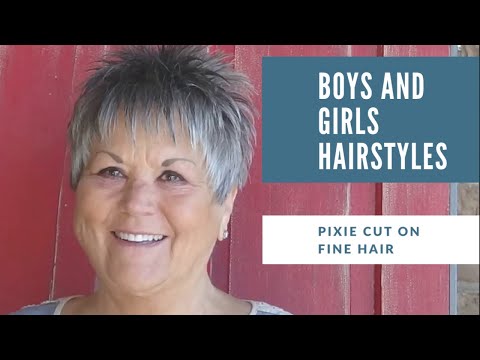
Cindy's Pixie shows the mechanical advantage of reducing length when crown lift is the priority. RaDona keeps the top just over an inch, tightens the sides and dries the hair with upward movement.
RaDona explains that Rochelle's texture is fine but she has a lot of hair. That is why substantial texture can work on Rochelle while being inappropriate for a woman whose scalp is already visible.
Shorter is not automatically better. Each family preserves a different amount of coverage.
Priority
Pixie
Bixie
Bob
Maximum crown lift
Best
Very good
Moderate
Temple / ear coverage
Lowest unless long Pixie
Very good
Best
Protect weak perimeter
Least relevant
Good
Best
Fast morning styling
Usually best
Very good
Good
Forgiving grow-out
Lowest
Very good
Best
Diffuse thinning
Good if scalp coverage remains
Strong middle ground
Good if ends remain solid
Tell the stylist where the density is weak
What to ask for when your hair is thinning after 50.
“I have thin hair” is not enough information.
A better salon request
“My lowest-density areas are [crown / center part / temples / front corners / perimeter]. I want enough shortness to create lift where I still have density, but I do not want aggressive texturizing in the sparse areas. Please preserve coverage through [specific area] and show me the dry shape before removing more.”
If you also have fine strands, say that separately: “My strands are fine, but my bigger concern is density here.”
A haircut can change appearance—not diagnose hair loss
When thinning deserves medical evaluation.
If your part is progressively widening, your temples are receding, your ponytail has become noticeably smaller, you are shedding much more than usual, you have patchy loss, scalp symptoms, or the change happened suddenly, talk with a qualified medical professional or dermatologist.
There are many possible causes of hair loss. A haircut can create better shape, coverage and visual fullness, but it cannot determine why density is changing or treat the underlying cause.
Why this guide is allowed to exist beside the fine-hair keeper
The decision model is different.
The fine-hair keeper is about strand diameter. This page is about density distribution. Vanita demonstrates strategic front-corner coverage. Cindy demonstrates short support when crown lift is the goal. Peggy and Rochelle are deliberate counterexamples proving that fine strands can still come with plenty of hair.
Primary diagnosisWhere is density missing?
Coverage proofVanita's front-corner strategy.
Lift proofCindy's short-support Pixie.
Guardrail proofPeggy + Rochelle are fine-but-dense.
Keep the architecture clean
Best next clicks from this thin-hair guide.
Density stays here; strand texture stays on the fine-hair keeper.
Parent age hub
Women Over 50
Use the age hub when thinning is only one of several haircut priorities.
RaDona's library shows why “thin” cannot be treated like one hair type.
RaDona Ludlow is a licensed cosmetologist and salon owner in Nephi, Utah who has worked behind the chair since 2000. Her videos reveal a detail generic galleries often miss: two women can both describe their hair as “fine” while one has substantial density and another needs strategic coverage.
This page is built around that distinction. The haircut should respond to the distribution of hair the client actually has.
Thin hair over 50: choose by density, not age stereotypes.
The location of thinning determines whether you should remove weight, preserve length, change the part or strengthen the perimeter.
What is the best hairstyle for thin hair over 50?
The best cut depends on where density is missing. A short Pixie can help a flat crown, a Bixie can preserve temple coverage, and a Bob can protect a weak perimeter.
What is the difference between thin hair and fine hair?
Fine hair describes strand diameter. Thin hair describes lower density or fewer hairs. You can have fine hair with lots of density, or coarse hair with reduced density.
What haircut helps thinning temples or front corners?
Preserve strategic front/side length. A longer Pixie, Bixie or side sweep can direct hair over sparse corners.
Should thin hair be heavily layered?
Not by default. Heavy layering can make low-density ends more transparent. Use layers only where they create useful lift.
Should thin hair be texturized?
Only selectively. Fine-but-dense hair can tolerate much more removal than genuinely low-density hair.
Is short hair always better for thin hair over 50?
No. Short hair can create lift, but cutting too short can expose scalp or remove valuable temple coverage.
When should thinning hair be checked by a dermatologist?
Progressively widening part, sudden or patchy loss, temple recession, scalp symptoms or a major change in shedding deserves medical evaluation.
The thin-hair rule
Protect the hair doing the coverage. Remove weight only where it creates useful lift.
Start by identifying the weakest zone, preserve the hairs doing the most visual work there, then use the rest of the haircut to direct shape and movement toward that area.