
True asymmetrical Pixie
- One side or front is cut to a different length.
- The imbalance remains when the hair is combed down.
- The shorter and longer zones are planned during the haircut.
- The fringe can be part of the structural asymmetry.
A true asymmetrical Pixie keeps unequal length on purpose: one side, the fringe, or the front stays noticeably longer while another area is cut shorter. RaDona’s real-client videos show everything from a soft longer-side Pixie to a dramatic Pixie-Bob.
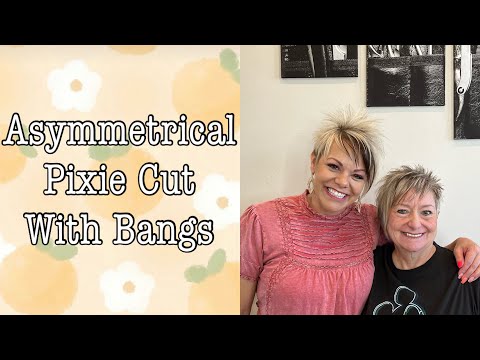
The easiest version keeps one side or the fringe somewhat longer. A stronger version cuts one side much shorter while preserving more length on the other. A Pixie-Bob pushes the idea farther by keeping enough exterior length to approach chin level on the longer side.
This distinction matters for search intent and for the salon consultation. If the structure is equal and only the finish sweeps to one side, it is still a regular Pixie styled asymmetrically.
The transcript is unusually clear: Brenda wants one side longer, the opposite side shorter, and an even more distinct difference than before.
The important choice is not whether the cut is “edgy.” It is how much length difference you want between the short and long zones.
PrimaryThis is the clearest foundation example. Brenda explicitly wants one side to keep growing longer while the opposite side is taken shorter so the asymmetry becomes more obvious.
Watch the real haircut → 412K+ views
RaDona’s 412K+ haircut is a stronger-contrast short asymmetric. The cut is point-cut and heavily textured, with one side/front deliberately preserved longer.
Watch the real haircut → 182K+ views
Jill’s 182K+ transformation is the useful bridge for someone who likes asymmetry but wants more exterior length. One side/front falls near chin length while the opposite side is much shorter.
Watch the real haircut →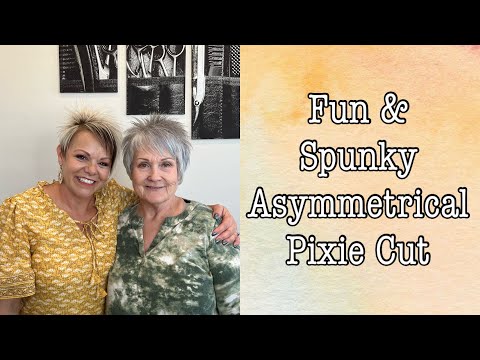 Grow-out
This is the reverse decision: Sharon already has an asymmetrical cut and is beginning to grow the shorter side so it starts matching the longer side. Good proof that asymmetry can be reduced gradually.
Watch the real haircut → Technique
A technique-first video showing a short back, spiky top and a front/side kept longer. RaDona angles the front so the hair drops longer and preserves the asymmetrical side.
Watch the real haircut → 2024
A short 2024 example on Shelley. The video is brief, so use it as current visual proof rather than a full cutting tutorial.
Watch the real haircut →Use these as haircut directions, then customize the exact length to your own density, texture and comfort.
Best when you want visible imbalance without a dramatic undercut. Keep one side or front longer and make the opposite perimeter cleaner and shorter.
Take the shorter side higher around the ear while preserving a noticeably longer opposite side. This makes the asymmetry obvious even with minimal styling.
Keep most of the Pixie short but preserve more front length. This is useful when you want facial softness without moving all the way into Pixie-Bob territory.
Keep substantially more exterior length on one side/front. Jill’s transformation reaches much closer to chin length and is the best bridge if a true short Pixie feels too abrupt.
Asymmetry does not have to be permanent. Sharon’s video shows the shorter side being preserved and grown so the contrast gradually becomes smaller.
Natural texture can amplify uneven lengths, but the side-to-side structure should still be intentional. If curl is your main concern, use the dedicated Curly Pixie guide too.
These are overlapping families, but the outside perimeter and long-side length change what the haircut reads as.
| Cut | Short side | Long side / fringe | Visual priority | Best next page |
|---|---|---|---|---|
| Classic Pixie | Short | Usually similar structure side-to-side | Short internal layers / perimeter | Pixie Haircuts |
| Soft asymmetric Pixie | Short | Moderately longer on one side/front | Controlled imbalance | This page |
| Bold asymmetric Pixie | Very short or strongly exposed | Clearly longer opposite side | Contrast | This page |
| Pixie with longer bangs | Can be similar both sides | Longer mostly through fringe | Front length | Pixie With Longer Bangs |
| Asymmetrical Pixie-Bob | Shorter back/side | Long enough to approach Bob territory | Exterior perimeter length | Pixie vs Bixie |
| Curly asymmetric Pixie | Varies | Varies with curl spring-up | Texture + unequal structure | Curly Pixie |
Bring a front view and both side views. The stylist needs to know exactly which side stays longer, where the short side should expose the ear, how much fringe you want and whether the long side should remain true Pixie length or approach a Pixie-Bob.
This older transformation is useful because the asymmetry is not subtle. The cut deliberately keeps more length through one front/side area while the opposite area is shortened and the entire shape is heavily point-cut and texturized.
It is a stronger reference than simply showing a regular Pixie brushed to one side.
The BGH video library includes asymmetrical cuts on women in their 50s, 60s and beyond. The practical question is how much contrast fits your style and how much time you want to spend directing the longer side.
For broader age-based haircut ideas, use the Women 50+ and Women 60+ hubs. Keep this page as the shape-specific decision guide.
Use the broad Pixie hub if you are still choosing between classic, textured, curly, fine-hair and asymmetrical versions.
If the longer side is approaching Bob territory, compare the Pixie with Bixie/Bob-like shapes before committing.
The shorter and longer zones grow at the same biological rate, so the visible proportion changes as the cut grows out.
The old site had two broad pages competing for this same intent. This rebuild consolidates the topic around verified BGH videos where the actual cut contains unequal length.
RaDona Ludlow is a licensed cosmetologist and salon owner in Nephi, Utah who has worked behind the chair since 2000. The strongest examples here include Brenda’s true short-side/long-side Pixie, RaDona’s own high-view asymmetric, Jill’s Pixie-Bob, and Sharon’s grow-out.
Choose the long side, the short side and the front length before the haircut begins.
The structure is intentionally unequal. One side, the fringe, or the front is kept noticeably longer while another area is cut shorter. Simply sweeping a symmetrical pixie to one side does not automatically make the haircut asymmetrical.
Yes. RaDona has multiple real clients over 50 and 60 wearing asymmetrical short cuts. Age is not the deciding factor; the useful decisions are how much contrast you want, where you want the longer side to fall, your density and your styling routine.
It can be subtle or strong. Brenda’s haircut keeps one side growing longer while the other is taken shorter. RaDona’s own asymmetrical cut uses a more obvious difference. Jill’s asymmetrical pixie-bob keeps much more length through one side/front.
Not necessarily. A true pixie can be asymmetrical while still having a very short perimeter. An asymmetrical pixie-bob keeps more exterior length, often through the front or one side. Jill’s transformation on this page is a useful example of that longer bridge style.
It can, but texturizing should match the actual density. Brenda’s and RaDona’s videos show texture being used to create separation and movement, but a stylist should not remove the same amount of weight from fine hair that they would from very dense hair.
Choose the side you want longer, identify the shortest point you are comfortable with around the opposite ear and nape, decide how long the fringe should remain, and show a front, side and back reference. The words “asymmetrical pixie” alone are not specific enough.
Decide which side stays longer, how short the opposite side may go, and whether the front remains true Pixie length or crosses into Pixie-Bob territory. Then use the real transformations above as the visual language for your stylist.