
Stacked Bob
Graduated layers build a rounded back. The front does not have to be dramatically longer.
A stacked bob is not just “a short bob with layers.” The stack is graduated structure through the back: shorter near the nape, progressively longer above, creating a rounded silhouette and controlled lift. The question is not whether stacking is good—it is how much stack your hair can support.

The back is cut with graduation: shorter hair sits beneath progressively longer sections so the silhouette rounds outward instead of dropping straight down. A soft stack gives subtle contour. A stronger stack creates more visible lift and a tighter nape.
The front can stay close to the same length as the sides, remain softly longer, or become a dramatic A-line. Those are separate choices.
Salon terminology overlaps. Instead of relying on one haircut name, describe the back graduation, nape length and front-to-back angle you actually want.
Graduated layers build a rounded back. The front does not have to be dramatically longer.
Often used for the same basic back-building technique, sometimes with a softer or less dramatic finish.
The front is longer than the back. It may be blunt, softly layered or strongly stacked.
Often combines a short graduated back with longer front pieces. Because terminology varies, bring a picture.
The more dramatic the stack, the more the back shape becomes the haircut. That also increases maintenance and makes density mistakes more visible.
A small amount of graduation adds contour without making the back look sharply layered.
Enough graduation to visibly round the back while keeping the haircut balanced and wearable.
A tighter nape and steeper graduation create the strongest back silhouette.
This full haircut shows the actual structure of a stacked Bob: establish the cut, build graduation in the back, connect the layers, blend the sides, then texturize and style only after the shape exists.

Linda’s age-61 transformation became one of RaDona’s strongest recent Bob videos because it combines three things women often want at the same time: a shaped back, movement through the layers and enough front length to stay soft around the face.
The lesson is not “copy Linda exactly.” It is to identify which part of the result you want: the rounded back, the crown movement, the face-framing front—or all three.
These real-client videos range from soft graduation to dramatic stacks. Use them to show your stylist the amount of lift and nape tightness you actually want.
A current RaDona stacked-bob example with a compact back and a polished modern finish.
A softer layered stack with movement through the crown and enough front length to keep the silhouette gentle.

A full start-to-finish stacked-bob tutorial showing graduation, layers, blending and styling.
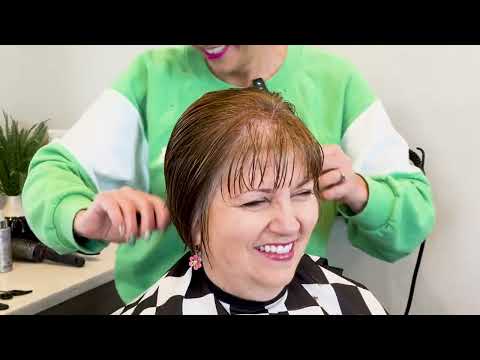
The back is stacked while the upper sections stay layered enough for movement instead of a hard helmet shape.
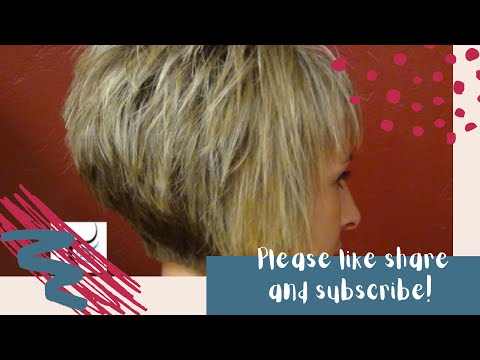
A compact shorter stacked shape with the back doing most of the structural work.

A more assertive stacked shape with stronger graduation and a sharper overall silhouette.

Combines a stacked back with asymmetry, creating a more directional front while keeping the rear lift.

Shows how a stronger front-to-back angle can be combined with stacked structure in the back.

A short visual example centered on how graduation and layering change the silhouette of thinner-looking hair.

Adds fringe to the stacked back, changing the face-framing balance while keeping the rear graduation.
Fine describes strand diameter. Thin or thinning describes density. You can have very fine strands and still have enough hair to support a substantial stack.
Usually the easiest match for stacking. The graduation can remove weight and build visible shape without making the perimeter look empty.
Use a softer stack. Keep more perimeter and be conservative with thinning shears or internal removal in sparse areas.
Stacking can remove bulk strategically. The goal becomes controlling weight so the back rounds instead of expanding outward.
Graduation changes where existing hair sits and where the eye sees volume. It does not increase strand diameter, create new follicles or treat hair loss.
Not because age requires a shorter haircut. The appeal is structural: you can move fullness upward while keeping softness and usable length around the face.
Graduation shifts the visual weight upward instead of letting the back lie flat.
The front can remain jaw length or longer even when the nape is much shorter.
A soft stack transitions more quietly; a dramatic short stack needs more frequent reshaping.
The amount of graduation can be reduced or increased without abandoning the Bob shape.
Two stylists can hear the same haircut name and picture different amounts of graduation. Geometry is more precise than terminology.
“I want a stacked Bob with the back sitting around [nape / above nape / lower nape]. I want the graduation [soft / classic / dramatic]. Keep the front around [chin / jaw / below jaw], and I want the front-to-back angle [almost even / softly longer in front / clearly A-Line]. Please keep enough perimeter for my density and show me the side profile before taking the stack higher.”
| Decision | Softer option | Stronger option | What changes |
|---|---|---|---|
| Nape | Lower / longer | Higher / tighter | How exposed and compact the back feels |
| Graduation | Soft stack | High stack | How round and lifted the back becomes |
| Front | Near-even Bob | Long A-Line front | How dramatic the side profile looks |
| Texture | Minimal removal | More internal texture | How airy vs solid the shape feels |
A one-length Bob can lose precision gradually. A short stacked nape changes more visibly because the lower layers grow away from the head and the graduation line drops.
Usually the most forgiving. The back can grow longer before the silhouette feels obviously different.
Expect regular reshaping if you want the rounded back to stay crisp and controlled.
The nape and graduation are the haircut, so growth becomes noticeable sooner.
Fringe may need attention before the rest of the Bob because it reaches the eyes quickly.
The best decision often becomes obvious when you compare what each haircut preserves—and what it removes.
Choose a classic Bob if you want a stronger lower edge and less visible graduation.
Explore Bob haircutsChoose A-Line when the front-to-back diagonal matters more than how much the back is stacked.
Compare A-Line BobsChoose a Pixie if easy crown lift and a more open neck/ear silhouette matter more than keeping Bob length.
Compare Pixie vs BobChoose a Bixie when you want Bob-like exterior length with shorter, more Pixie-like internal movement.
Compare Bixie vs BobUse this when visible density—not haircut geometry—is the main problem you are trying to solve.
Bob haircuts for thin hairUse this when the strands themselves are fine, even if overall density is still high.
Bob haircuts for fine hair
RaDona Ludlow is a licensed cosmetologist and Utah salon owner who has worked behind the chair since 2000. Her video library includes hundreds of real Bob, stacked Bob, A-Line and short-hair transformations on actual salon clients.
That real-client archive matters because a stacked Bob looks very different on fine, thin, dense, straight and wavy hair. Seeing the starting hair is often more useful than seeing only the finished cut.
These are the questions worth settling before the appointment.
A stacked Bob uses graduated layers through the back so the lower nape is shorter and the shape builds upward into a rounded, lifted silhouette. The front can be nearly even, slightly longer, or strongly angled.
Stacked describes graduation through the back. A-Line describes a perimeter that is shorter in back and longer in front. A haircut can be stacked without a dramatic A-Line angle, A-Line without much stacking, or both.
The terms overlap heavily. Both describe shorter layers built through the back to create shape. Some stylists use “graduated” for a softer or more technical description and “stacked” for a more visibly rounded result.
They can be a strong option because back graduation can create shape while the front stays soft and face framing. The right version depends on density, texture, maintenance and how much lift you want—not age alone.
Fine hair can work very well with a stacked Bob when there is enough density to support graduation. Fine but dense hair can usually carry more layering than fine, low-density hair.
It can be, but low-density hair generally needs a softer stack and less texturizing so too much visible density is not removed from the perimeter.
A visible short stack usually needs reshaping more often than a one-length Bob because the nape and graduation lose structure as they grow. Many women prefer a reshaping roughly every 5 to 8 weeks depending on how short the back is.
Describe four things: back length, amount of graduation, front length and whether you want a visible A-Line angle. Bring a real-client photo or video whenever possible.
A good stacked Bob moves fullness to the back and crown without hollowing out the perimeter. Start with the nape, choose soft/classic/dramatic graduation, then decide how much front angle you want.